A GREEK’S GUIDE TO GREECE
Published: 9th of June 2026
This is not a sponsored post and I am not affiliated with any of the businesses or organisations mentioned.
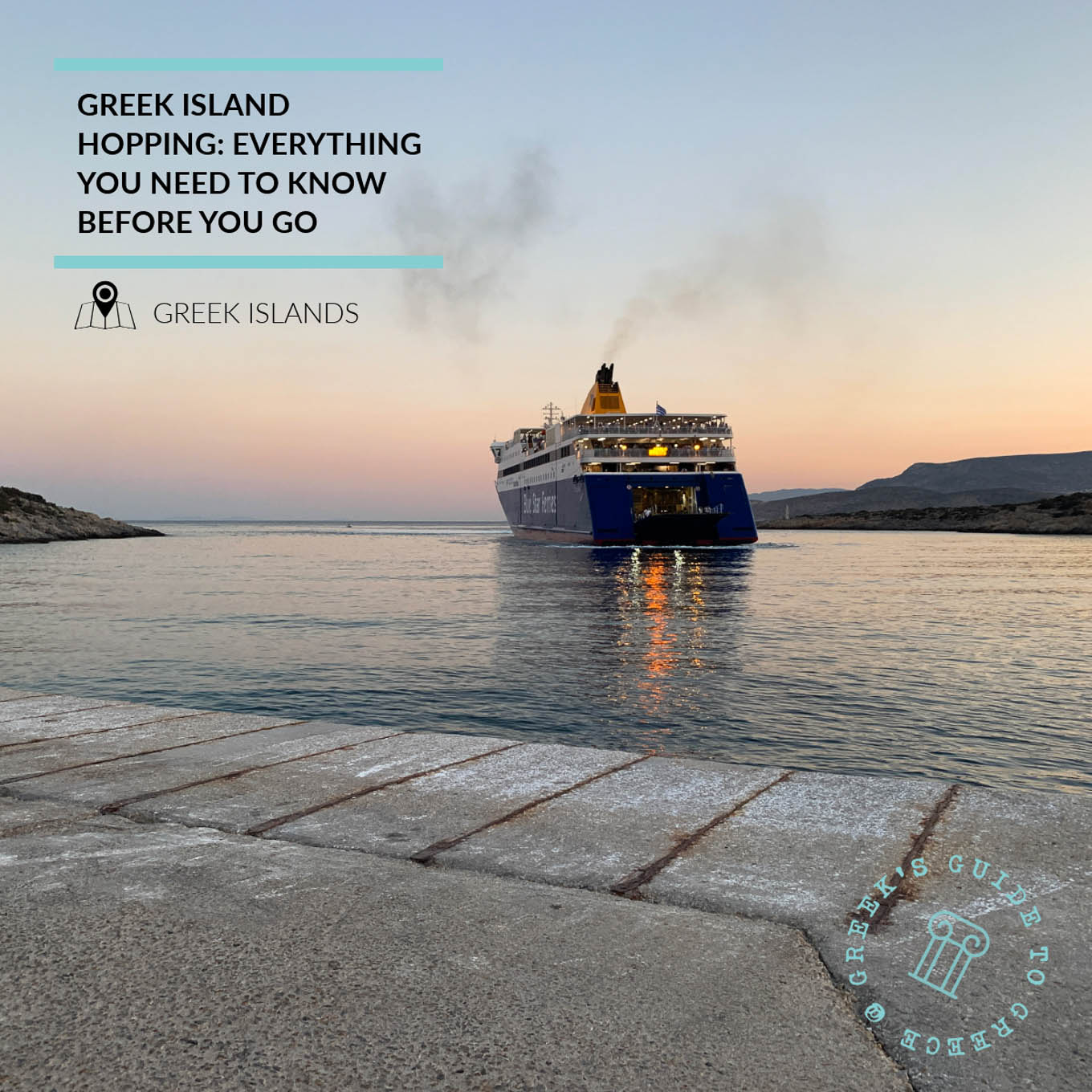
Over the years, while writing island hopping itineraries and destination guides for the Greek islands, I found myself repeatedly answering the same questions. Some of those answers were buried inside other articles, while others never quite fit anywhere at all.
More importantly, these are the same questions that first-time visitors to Greece tend to ask again and again.
Is island hopping easy? How many islands should I visit? Do I need a backpack? Are the ferries safe? This guide brings all of those answers together in one place.
So, if you are planning your first Greek island hopping trip, grab a coffee and let’s get started.
WHAT DO WE MEAN BY GREEK ISLAND HOPPING?
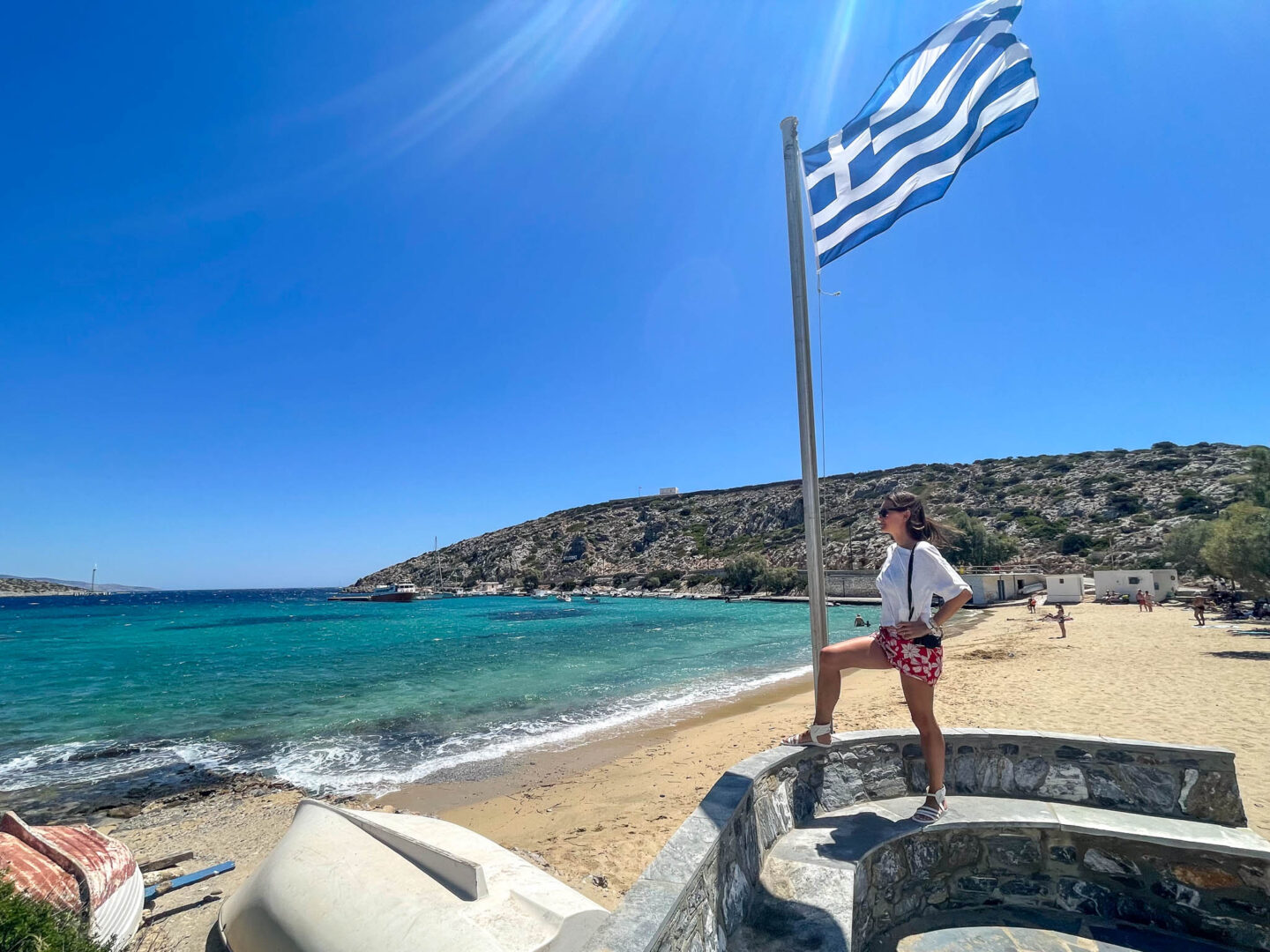
What I, and most people, mean by island hopping in Greece is travelling from one island to another using public ferries.
Taking a cruise or sailing on a private yacht is, theoretically, also island hopping, but those are completely different experiences and we will not be discussing them here.
Some people who don’t like boats may now wonder whether it is possible to fly between islands instead.
Many Greek islands do not have an airport at all. The largest or most populous islands in the Aegean and Ionian Seas do have airports (domestic or international), but these are primarily designed to connect the islands with the mainland -usually Athens and, in some cases, Thessaloniki- and various cities abroad.
Direct flights between Greek islands are very limited. At the time of writing, only a handful of routes exist, mainly amongst the islands of the Dodecanese, operated by Aegean Airlines and Sky Express. Both are established airlines, so if one of their routes happens to fit your itinerary, by all means take advantage of it.
Hiring a private helicopter is also possible but, unsurprisingly, very expensive. Every so often, new start-up companies appear with ambitious plans to introduce Maldives-style air transfers between islands. I have no personal experience with these services and, at least for now, this remains very new territory.
The reality is that ferries are the backbone of transportation in the Greek islands. If you want to travel between islands in an affordable and practical way, public ferries are almost always the answer.
And that is exactly what we will be discussing in this post.

IS ISLAND HOPPING IN GREECE EASY?
I honestly believe that island hopping in Greece may be the easiest island hopping you will ever do in the world. I hope that by the end of this blog post, you will feel the same way too.
Island hopping in Greece is safe (I will explain this further later), reliable and, at least in the last 5–7 years or so, 99% of the process can be planned and booked from the comfort of your own home. Ferry schedules are published online, tickets can be booked in advance and accommodation is readily available through the usual booking platforms.
I have previously explained all about how to book ferries (and flights) to the Greek islands as well as transiting from the ports and airport of Athens, so I won’t go into further detail here.
Even if you prefer a more spontaneous style of travel, that’s easy to do as well. There are travel agents and ticket offices at every port that can help you with routes, schedules and ticket bookings. More importantly, I have yet to find a person working in the Greek travel industry who doesn’t speak a good level of English.
Of course, things can occasionally go wrong. Ferries can be delayed, routes can change and strong winds can sometimes disrupt schedules. However, these situations are generally the exception rather than the rule. For the vast majority of travellers, island hopping in Greece is a straightforward and surprisingly stress-free experience.
HOW MANY DAYS SHOULD YOU STAY ON EACH GREEK ISLAND?
Ok, we have a lot to unpack here, so bear with me.
As you will see in my Santorini island hopping itineraries, Mykonos island hopping itineraries and Paros island hopping itineraries, I typically allow for three full days on each island, and that’s for big and small islands alike.
Just to clarify, when I say ‘three days’, I generally mean three overnight stays. Remember that even a short 1h ferry ride, with transfers before and after, and checking in and out of hotels can easily eat up a large chunk of the day.
Now, I am not saying that every Greek island deserves exactly three days. Rather, when I first start planning an island hopping trip, I usually begin by allocating three days per island. It is a simple rule of thumb that helps me estimate the overall length of the trip, book flights in and out of Greece, arrange annual leave and put together a rough budget.
The 3-day rule is something I have developed over years of travelling around the Greek islands and it revolves around two core ideas.
DO NOT UNDERESTIMATE THE LOGISTICS
A Greek island hopping trip typically involves at least two or three islands and, quite often, a short stay in Athens as well.
On any multi-stop trip, anything shorter than a three-day stay at each destination can become surprisingly exhausting. Between packing, unpacking, checking in and out of hotels, transferring to ports, waiting for ferries and finding your way around a new place, a lot of time disappears into logistics.
As we all know, the worst part of travelling is often… the travelling itself.
Many island hopping itineraries you find online try to squeeze as many islands as possible into a short timeframe. While there is nothing wrong with that, I find that people often underestimate how tiring it can be to move every day or two.
If you prefer a faster pace, another option is to alternate between shorter and longer stays. For example, spend two nights on one island and then four or five nights on the next. This gives you some time to decompress after the more hectic parts of the trip.
WHAT’S YOUR INTENTION?
Once you move beyond the initial planning stage and start putting together a detailed itinerary, it’s worth considering a few additional factors.
WHICH ISLANDS DO YOU PLAN TO VISIT?
Before settling on an itinerary, have a look at the individual guides for each island (you can find all of my individual island guides in my Greece page). This will help you decide whether a destination genuinely matches your interests or whether you’re simply including it because it is famous and looks beautiful.
For example, perhaps you’re visiting Mykonos out of curiosity, or because you can fly there directly from your home airport, but you’re far more interested in smaller and more under the radar Greek islands. If that’s the case, don’t hesitate to adjust your itinerary accordingly and spend more time where you think you’ll enjoy yourself most.
ARE YOU VISITING ‘BIG’ ISLANDS WITH LOTS TO DO?
By ‘big’ island, I mean two things. Either geographically large islands, such as many of the Ionian islands, Rhodes, Andros or Amorgos, or islands that, despite their size, offer an enormous amount to see and do, such as Santorini, Mykonos and Sifnos.
In either case, if you actually want to experience the island rather than simply tick it off a list, I would recommend a minimum of three days. There is usually more to see and greater distances to cover than first-time visitors expect.
ARE YOU VISITING ‘SMALL’ ISLANDS WITH SEEMINGLY NOT MUCH TO DO?
Someone might ask why I would recommend spending three days on a tiny island.
Well, on smaller islands, the whole point is to slow down, switch off and enjoy the serenity of the place. It’s about embracing that unique ‘small island feeling’. You are unlikely to experience that during a rushed overnight stay.
In fact, this is where many first-time visitors get caught out. They assume that a small island only requires a day or two, when often the entire appeal lies in doing very little at all. Some of my favourite memories from the Greek islands involve long beach days, lazy lunches and evenings spent wandering around a quaint port with no particular plan.
Of course, if you are travelling from North America, Australia or Asia and this is a once-in-a-lifetime trip, you may decide to move faster in order to see more places. That is perfectly understandable and there is nothing wrong with that approach either.
At the end of the day, no matter what I say, trust your gut. Do you want to see as many places as possible? Do you want to slow down, get some rest and enjoy a more relaxed pace? Or maybe explore a handful of destinations in depth?
There is no right or wrong answer. Both approaches are perfectly valid, as long as you are happy with your plan.

HOW MANY GREEK ISLANDS SHOULD YOU VISIT?
Ferries in Greece are quite fast these days and the next incredible island may only be an hour away. What a temptation, right?
The only honest answer to this question is:
As many islands as you can sustainably travel to without feeling like you spent half your holiday carrying luggage through ports and sitting on ferries.
This is a deeply personal decision and the answer depends entirely on what you want to get out of your trip.
On the island hopping itineraries I feature on this blog, I usually include a minimum of three destinations and, in many cases, considerably more. The purpose of these itineraries is to showcase different routes and possibilities, not to make you feel like you need a month in Greece in order to have a worthwhile trip.
I love putting together ambitious island hopping itineraries, but if you only have a week or less, I firmly believe that less is more.
Remember that you are not travelling between museums or landmarks. You are travelling between places where the whole point is often to slow down, go to the beach, swim in the sea, enjoy a long lunch and watch the sunset.
For that reason, if you have less than a week available, two islands are usually more than enough to get a taste of Greek island life and create memories that will stay with you for years.
Could you visit more? Absolutely.
The real question is whether doing so would actually improve your holiday.
SHOULD YOU BOOK GREEK FERRIES IN ADVANCE?
The short answer is yes, especially if you are travelling in July or August.
The slightly longer answer is that I would strongly recommend booking in advance if any of the following apply:
- Your plans are time-sensitive.
- You want to travel on a specific day.
- You want to travel on the fastest boat.
- There is only one ferry serving your route every few days.
- You are travelling on a long route and would like to book a cabin.
- You need to reach Athens in time for an international flight.
In all of these situations, I see very little advantage in leaving things to chance.
One thing worth remembering is that ferry schedules vary throughout the season. July and August are naturally the busiest months, but they also tend to have the highest number of ferry departures. During May, early June and late September, there are fewer travellers but also fewer scheduled services. In some cases, this means that certain routes may only operate a handful of times per week.
That said, not every ferry ticket needs to be treated like a military operation.
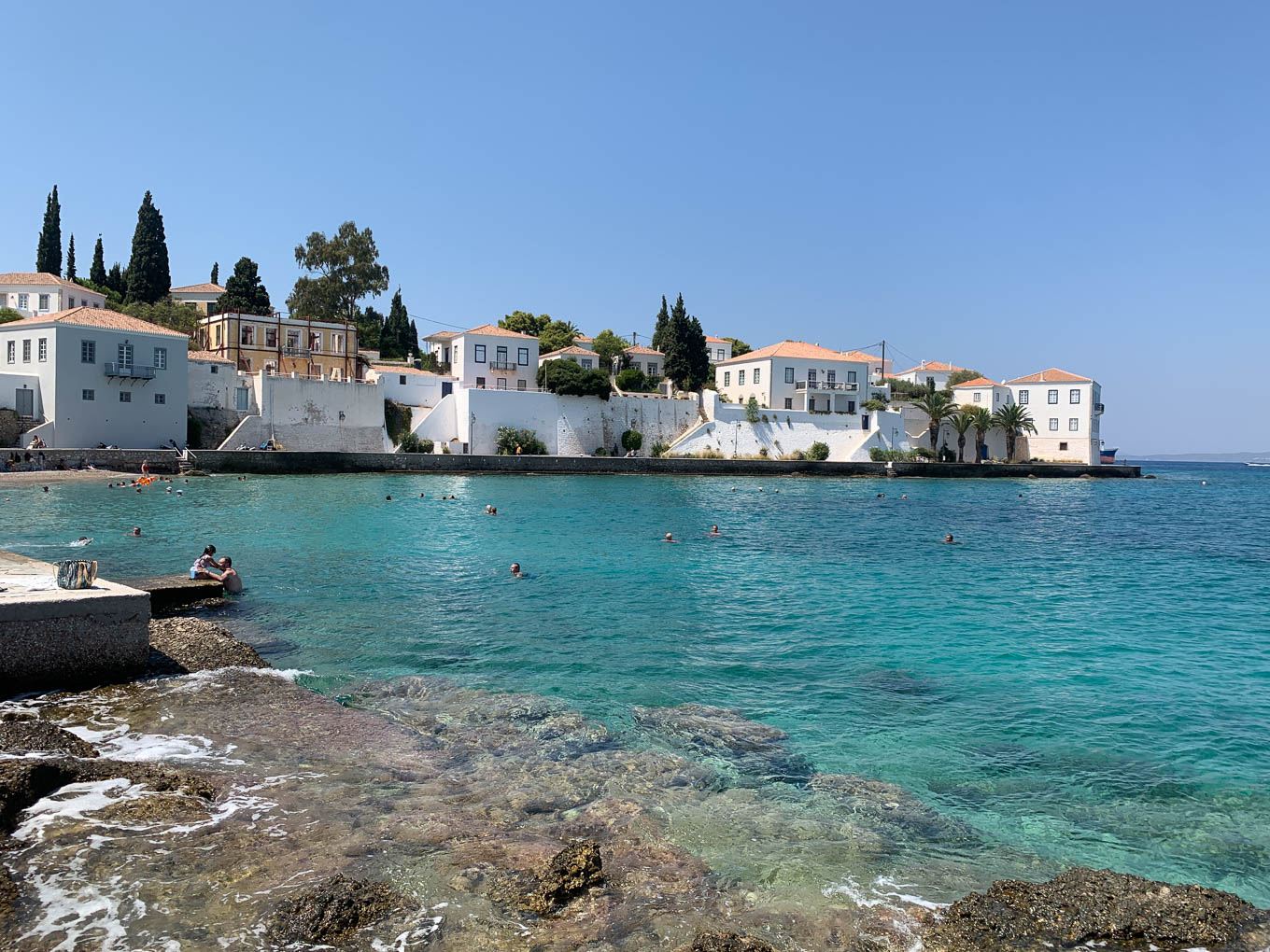
For a casual day trip between neighbouring islands, I generally wouldn’t worry too much. For example, travelling between Hydra and Spetses is easy and there are usually multiple daily departures during the summer season. I have done this trip several times over the years and I almost always buy my ticket from the ticket office on the same day.
Similarly, if you are travelling slowly and enjoy a more spontaneous style of travel, booking last minute is still perfectly possible. Plenty of people continue to do exactly that.
Unless you are travelling on a particularly niche route, you will usually find a ticket. The difference is that it may not be on the fastest ferry or at your preferred departure time.
HOW FAR IN ADVANCE SHOULD YOU BOOK?
Personally, if I already know which route I want to take, I don’t see much reason to wait. Ferry schedules for the summer season are usually released between January and March, although this varies from company to company.
If I were travelling in August, I would aim to have the most important routes booked by May. This is not because ferries always sell out, but because I like having a choice of departure times and ferry operators.
And for any journey that could affect an international flight home, I would book as early as possible and leave myself a comfortable buffer.
DO YOU NEED A BACKPACK TO ISLAND HOP IN GREECE?
Many people associate island hopping with backpackers travelling with nothing more than a rucksack. While that may be true in some parts of the world, it doesn’t really reflect the reality of modern travel in Greece.
Will travelling with a suitcase make hopping on and off ferries difficult? The answer is absolutely not. I have travelled to countless Greek islands over the years, including some very small and obscure ones, and I have almost always done so with a medium-sized suitcase. My husband does the same.
In most ports, ferries are boarded via a large ramp, meaning there are usually no stairs involved. Depending on the ferry and the circumstances, staff members may occasionally help passengers with luggage, particularly families, elderly travellers or people with mobility issues. However, I wouldn’t rely on this. You don’t need a backpack, but you should be able to lift your suitcase over the occasional step, kerb or obstacle without assistance.
It’s also worth noting that larger luggage is usually stored in a designated luggage area on board. Depending on the ferry, you may also be allowed to keep a smaller cabin-sized suitcase with you in the passenger areas.
As with any form of travel, keep valuables, passports, medication and anything else you absolutely cannot afford to lose in a smaller bag that stays with you at all times. I follow Greek news fairly closely and can’t recall hearing about widespread theft from ferry luggage areas, but it’s always better to be safe than sorry.
One thing that often surprises first-time visitors is that many hotels and guesthouses on smaller islands offer complimentary transfers from the port. It is quite common to arrive and find the owner waiting with a minivan to collect both you and your luggage. Interestingly, this is often more common on smaller islands than on larger and busier destinations. On islands such as Santorini, Mykonos or Paros, even luxury hotels may expect guests to arrange their own transport, whether that’s a taxi, private transfer or rental vehicle.
THE ART OF TRAVELLING LIGHT… BUT DON’T SWEAT IT
That said, if your itinerary involves a lot of islands, travelling light will make your life easier. This has less to do with ferries and more to do with repeatedly packing, unpacking and moving between hotels.
In my humble opinion, it’s actually better to have a slightly larger suitcase that is packed loosely than a small bag that is bursting at the seams and requires competition levels of Tetris skills in order to pack every time you change accommodation. But that comes down to personal preference.
The bottom line is that you do not need a backpack to island hop in Greece. Bring whatever luggage works best for your travel style and don’t overthink it.
WHAT ARE GREEK FERRIES ACTUALLY LIKE?
I should probably start by saying that if you are looking for authentic experiences while on holiday in Greece, it doesn’t get much more authentic than this. Getting on a ferry to a Greek island is, in itself, the real deal.
Greeks from the mainland use ferries for their own holidays and, more importantly, these vessels are a lifeline for island communities. They transport people, vehicles, goods, post and supplies, while also enabling islanders to reach the mainland throughout the year.
Having said that, let’s discuss what it’s actually like. Many first-time visitors imagine one of two extremes.
Extreme 1: A tiny boat bouncing around in rough seas.
Extreme 2: A luxury cruise ship.
In reality, most Greek ferries sit somewhere in the middle. They are generally large, modern vessels carrying hundreds of passengers every day and are usually far more comfortable than people expect.
Most ferries feature air conditioning, toilets, cafés or cafeterias and designated seating areas. On longer routes, you may even find cabins, lounges and proper restaurants. So don’t expect to rough it.
The reason I say ‘generally large’ is because explaining size is a little tricky. Size is relative and it depends greatly on the type of ferry you happen to be travelling on.
Broadly speaking, most visitors will encounter two main types of ferries in Greece.
ABOUT CONVENTIONAL FERRIES
These are the classic ferries that carry both passengers and vehicles. They typically feature open decks, while the interior spaces may be arranged as lounges, airline-style seating areas or a combination of both. Many conventional ferries serving longer routes also offer cabins and larger dining areas.
They are slower than high-speed ferries but, in my opinion, considerably more enjoyable.
You can sit outside on deck and enjoy the wind in your hair, the sun on your face and uninterrupted views of the sea and the horizon. To me, this is the classic Greek summer experience and, as an added bonus, conventional ferries are often cheaper than their high-speed counterparts.
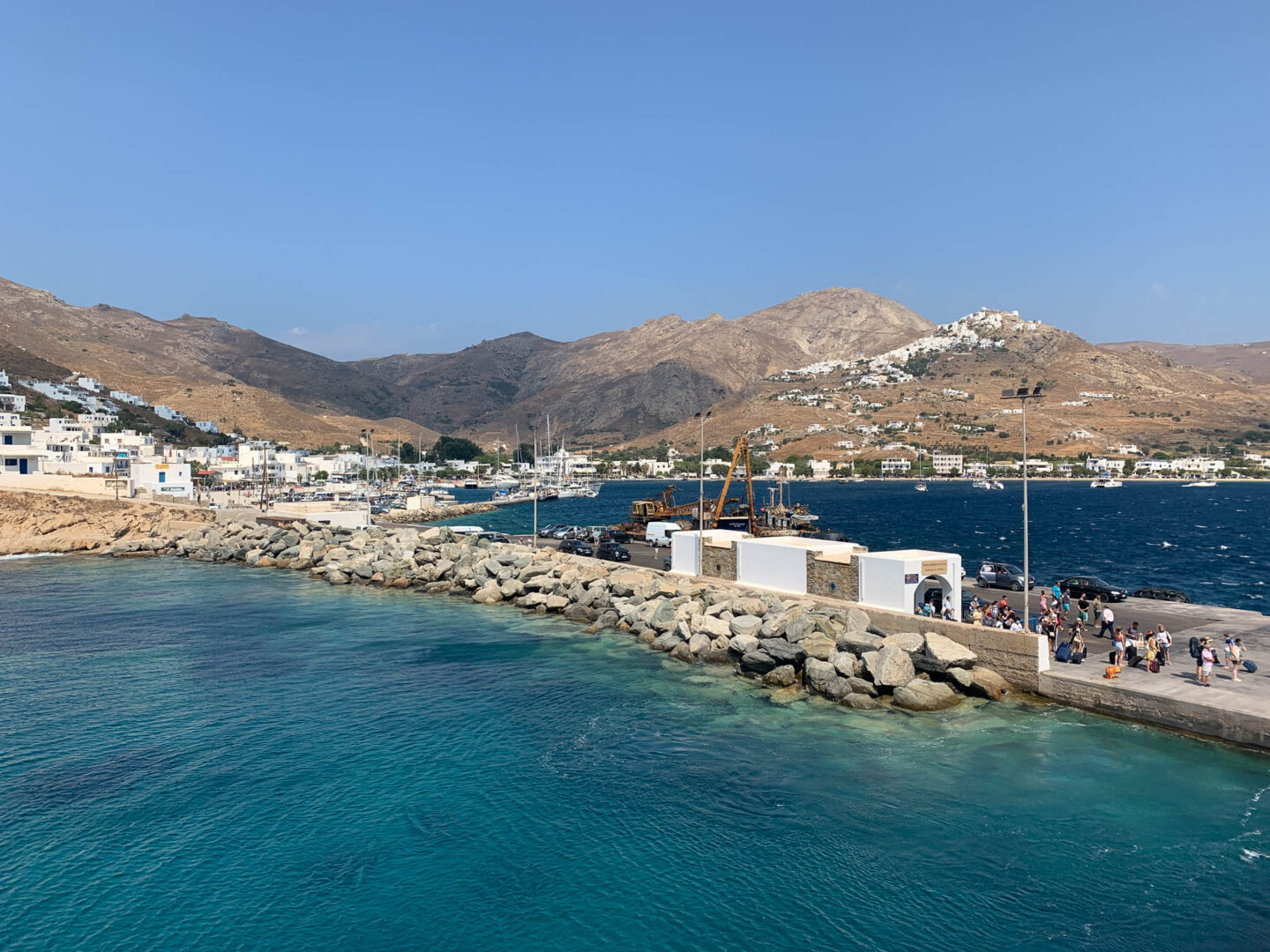
Furthermore, being on deck as the ferry approaches an intermediate port of call is one of the best ways to scout another destination. On many Greek islands, the main town is also the port or, at the very least, visible from it. You can often get a surprisingly good feel for an island’s landscape, architecture and atmosphere before you even step ashore.
As I often mention in my Santorini guides, arriving by sea in Santorini is one of the most memorable experiences you can have in Greece. Seeing the island rise out of the water for the first time is something that will stay with you for years.
One thing to keep in mind is that outdoor decks often have limited shaded seating and those seats tend to fill up quickly. The wind can also trick you into forgetting how strong the Mediterranean sun really is. If you plan to sit outside, make sure your sunscreen is in your day bag and not buried somewhere in your suitcase.
ABOUT HIGH-SPEED FERRIES
High-speed ferries are usually what I refer to elsewhere on this blog as catamarans.
They are typically enclosed vessels with airline-style seating and a small café or bar serving drinks and snacks. They may feel slightly more modern than conventional ferries, largely because many of them are newer, but the overall experience is a little less atmospheric in my opinion.
Their main advantage, however, is speed. Depending on the route, a high-speed ferry can reduce the journey time by several hours, which can make a significant difference on a busy island hopping itinerary.
Because they travel faster and are generally lighter than conventional ferries, they can sometimes feel a bit bouncier in windy conditions. Some high-speed ferries are enormous, while others, particularly those carrying passengers only, can be considerably smaller.
All in all, conventional boat or high speed ferry, if you are wondering whether you are about to spend three hours on a wooden bench of a tiny boat holding on to your luggage and dear life, the answer is usually no.
IS ISLAND HOPPING IN GREECE SAFE?
I am not a maritime expert and I don’t write this post in any official capacity. I am simply a Greek person who has spent many years travelling around the islands. Although I currently live in London, I still keep up with Greek news and trust me when I say that if there is even the slightest whiff of an incident involving a Greek ferry, it makes the national news almost instantly.
Considering the enormous number of ferry crossings that take place every year in Greece, serious incidents are exceptionally rare.
One thing that international visitors sometimes forget is that these are not tourist boats operating only during the summer months. Greeks use ferries themselves to visit family, travel for work, transport goods and, of course, go on holiday. For many island communities, ferries are an essential part of daily life and a year-round connection to the mainland.
Maritime tradition in Greece is also a source of national pride. People working in the shipping industry generally take their profession very seriously and crews are highly trained. Greece has a long maritime history and some of the world’s largest shipping companies are Greek-owned, so expertise in this sector runs deep.
It’s also worth noting that weather conditions throughout the Aegean and Ionian Seas are closely monitored by the authorities. When conditions are considered unsafe, official sailing bans are issued and ferry services are suspended. In other words, it is not simply up to each captain or ferry company to decide whether conditions are acceptable for sailing.
This is one of the reasons why you will occasionally hear travellers complain that their ferry was cancelled due to strong winds. While inconvenient, this is actually evidence that the safety system is working exactly as intended.
So even if your crossing becomes a little bumpy, sit back and relax. A rough ferry ride may be uncomfortable, but that doesn’t mean it is unsafe. In fact, after many years of travelling around the Greek islands, I can honestly say that ferry safety has never been something I have personally worried about.

DOES IT GET ROUGH ON THE FERRIES?
Rough is a relative word but, yes, ferry crossings in Greece can occasionally be a little rough.
I am not saying this to make you nervous. Quite the opposite, actually. What I am trying to say is that if you happen to experience a bumpy crossing, it does not mean that something unusual or dangerous is happening. Ferry crews are used to operating in these conditions and, as I explained in the previous section, sailings are suspended when weather conditions are considered unsafe.
In other words, a rough crossing and an unsafe crossing are not the same thing.
That said, some routes are certainly more prone to choppy conditions than others. This is particularly true around the outer edges of the Cyclades, where islands such as Milos, Folegandros, Santorini and Amorgos are more exposed to the open sea.
The Cyclades can also be affected by the strong northern wind known as the meltemi, which blows most frequently during July and August, precisely when most people visit Greece.
High-speed ferries can sometimes feel rougher than conventional ferries, even when sea conditions are relatively moderate. Because they travel faster and tend to be lighter, passengers are often more aware of the movement of the boat.
TIPS FOR COMFORTABLE BOAT JOURNEYS
If you are not particularly comfortable on boats and would like the smoothest possible experience, here are a few things worth considering:
- If you are prone to seasickness, take your medication before boarding, even if the weather looks perfect. A sunny day in Greece does not necessarily mean calm seas.
- Try to avoid very long ferry journeys. One of the reasons I rarely recommend marathon ferry crossings on this blog is that most people can tolerate an hour or two of choppy conditions far more easily than five or six. If possible, fly to islands that are far from Athens and then continue your trip using shorter ferry crossings.
- Larger ferries generally feel more stable than smaller ones. If you have a choice of operators, it can be worth looking up the vessels beforehand.
Most importantly, try to relax.
Bring a book, or put on some good headphones, watch a film, listen to a podcast and focus on something enjoyable during the crossing.
And if you are feeling genuinely nervous, don’t be embarrassed to chat to the crew. In my experience, they are often very friendly and surprisingly reassuring. I remember one particularly bumpy crossing between Amorgos and Santorini when members of the crew started chatting with my friends and me. They casually explained that what we were experiencing was nothing compared to conditions they had encountered while working on cargo ships and freighters!
Finally, I hope that if you are currently at the planning stage of your trip, I haven’t discouraged you from booking those ferry rides! Remember that, in all likelihood, you will encounter calm seas and perfectly comfortable crossings. Most ferry journeys in Greece are completely uneventful. A sunny day on the open deck of a ferry, watching one island disappear on the horizon while another slowly comes into view, is a fantastic experience in its own right.
I am not the most comfortable person on boats but some of my favourite memories from the Greek islands have taken place between destinations rather than on them. The ferry journey is not just a way of getting from A to B. It is part of the island hopping experience.
USEFUL APPS FOR ISLAND HOPPING IN GREECE
Most people won’t need any special apps while island hopping in Greece. However, if you enjoy tracking ferries or keeping an eye on weather conditions at sea, there are a couple of tools that I have found useful over the years.
If you are keen on tracking the movements of your ferry, you can download a vessel-tracking app on your smartphone. I have personally used both MyShipTracking and MarineTraffic and they have worked well for me. Both apps operate worldwide. MarineTraffic probably offers the most features, while MyShipTracking keeps things simple and is completely free.
These apps can be particularly useful if you are waiting for a ferry to arrive, want to check its progress during a longer journey or are simply curious about the many ships moving around the Greek islands.
If you also wish to check weather conditions at sea, Buoyweather provides marine forecasts including wind speed, wave height and other useful information. Once again, the app works worldwide and its basic functions are available for free.
FINAL THOUGHTS
If you’ve made it this far, I hope I have convinced you that island hopping in Greece is far easier than many first-time visitors imagine.
Yes, there are ferries to book, routes to plan and the occasional windy crossing to contend with. But for the most part, the process is straightforward, the ferry network is extensive and travelling between islands is part of the adventure rather than an obstacle to it!
My biggest piece of advice is this: plan, but don’t overthink it. Pick a few islands that appeal to you, allow yourself enough time to enjoy them and embrace the journey in between.
After all, that’s what Greek island hopping is all about.
And if you’re ready to start putting together your own itinerary, don’t forget to have a look at my guide to booking ferries and flights in Greece and my guide to transiting from the ports and airport of Athens as well as my Santorini island hopping itineraries, Mykonos island hopping itineraries and Paros island hopping itineraries,
This is not a sponsored post and I am not affiliated with any of the businesses or organisations mentioned.
A DEEP DIVE INTO GREECE
Looking for more travel guides for Greece? Or maybe just tips, inspiration and practical advice for effortless travel and authentic experiences? Hit the buttons below!
___